
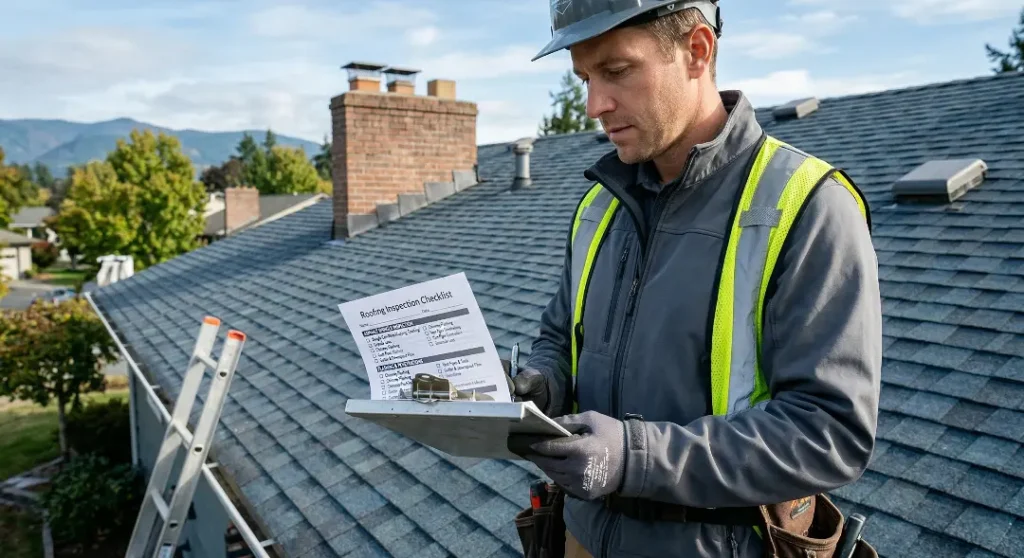
Your roof is one of the most expensive components of your home, and in the Pacific Northwest, it works harder than almost anywhere else in the country. Redmond, Washington, sees a persistent mix of heavy rainfall from October through April, strong windstorms, freeze-thaw cycles near the Cascade foothills, and the kind of relentless moisture that accelerates moss, lichen, and wood rot. A roof that looks fine from the driveway may be quietly failing above your ceiling.
The good news is that most roof problems are caught early through a simple, systematic inspection. This DIY roof inspection checklist is written specifically for Northwest homeowners and covers the 10 areas that matter most in a Redmond climate. You do not need special tools or professional training to work through this list. What you need is a safe ladder, a pair of binoculars, a notepad, and about 90 minutes of your time once a year.
According to OSHA’s falls prevention guidelines, falls from ladders are among the leading causes of home injury. Unless you are comfortable and experienced on a pitched roof, conduct the majority of this inspection from the ground using binoculars, and limit ladder use to gutter and eave-level observation only. Never walk a wet or mossy roof.
Why Annual Inspections Matter for Northwest Homeowners
Most roofing professionals and building science organizations recommend inspecting your roof at least once a year, ideally twice: once in early spring after the main rainy season, and again in late fall before heavy precipitation returns. The National Roof Certification and Inspection Association (NRCIA) notes that the majority of premature roof failures are caused not by sudden damage but by small, overlooked defects that compound over multiple seasons.
In Redmond specifically, National Weather Service data shows the region averages more than 150 rainy days per year. That sustained moisture exposure makes Western Washington roofs statistically more vulnerable to:
- Biological growth (moss, algae, and lichen), which traps moisture and degrades shingles from below
- Flashing failures caused by freeze-thaw cycling in higher-elevation neighborhoods
- Gutter and downspout blockages from conifer needle accumulation
- Wood rot along soffits and fascias in shaded, north-facing elevations
- Ice damming in years with colder winters and significant snowfall at the foothills
Catching any one of these issues early can save thousands of dollars. A flashing repair costs a few hundred dollars. Replacing water-damaged roof decking and interior drywall can reach $10,000 or more. An annual Northwest homeowner roof check is the most cost-effective maintenance habit you can build.
Check 01: Shingles and Overall Surface Condition
What to look for: Missing shingles, curling edges (either upward cupping or downward clawing), cracked or brittle shingles, blistering caused by moisture or heat, and granule loss visible as dark bare patches on the shingle surface. Granule loss is one of the most reliable indicators that asphalt shingles are nearing end of life.
How to check it: Walk the perimeter of your home and use binoculars to scan each roof plane systematically. Also check your gutters and downspout discharge areas for excessive granule accumulation after a rain event. A small amount of granules is normal; a significant buildup suggests accelerated wear.
Shaded north-facing slopes in Redmond deteriorate faster due to sustained moisture and limited drying time from sun exposure. Always pay extra attention to these surfaces during your inspection.
If you find areas of concern, review the roof repair options available for your shingle type before deciding whether a patch or a larger section replacement is needed.
Check 02: Moss, Lichen, and Algae Growth
What to look for: Any green, gray, or black biological growth on the shingle surface. Moss is the most common problem in Western Washington and is identifiable by its raised, spongy texture. Lichen (the flat, gray-green crusty growth) is more aggressive and harder to remove. Black streaking is typically blue-green algae (Gloeocapsa magma), which affects curb appeal and traps UV-damaging moisture against the shingle surface.
Why it matters: Washington State University Extension has documented that moss on asphalt shingles acts as a moisture reservoir, keeping shingle material saturated long after rain events and dramatically accelerating granule loss. Read the WSU Extension guidance on roof moss management for regionally specific treatment recommendations.
What to do: Low-pressure zinc sulfate or potassium bicarbonate treatments are effective and less damaging than pressure washing. Never pressure wash asphalt shingles; it removes protective granules and voids most manufacturer warranties.
Check 03: Gutters and Downspouts
What to look for: Clogged gutters, standing water or debris visible from ground level, sagging or separated gutter sections, rust or holes in metal gutters, downspouts that discharge too close to the foundation, and improper slope. Gutters should slope roughly 1/4 inch per 10 feet toward the downspout opening.
Why it matters: Blocked gutters during a Redmond rainfall event cause water to back up under the drip edge and soak into the fascia board, roof deck, and eventually the interior wall cavity. The EPA’s mold prevention resources identify chronic moisture intrusion at the roofline as one of the primary drivers of hidden mold growth inside wall assemblies.
How to check it: Run a garden hose into the gutter at the high end and watch for water flow toward the downspout. Also verify that all downspout extensions direct water at least 6 feet from your foundation.
Learn more about Northwest-specific gutter maintenance on our gutter services page.
Check 04: Flashing Around Penetrations and Transitions
What to look for: Flashing is the thin metal used to waterproof joints where the roof meets vertical surfaces: chimneys, walls, dormer sides, vent pipes, and skylights. Look for lifted or separated flashing, missing sealant at joints, rust staining, visible gaps, and any areas where flashing appears to have pulled away from an adjacent surface.
Why it matters: Flashing failures are one of the top three causes of residential roof leaks, according to the NRCIA. In the PNW, freeze-thaw movement, thermal expansion, and high rainfall volume all stress flashing joints more aggressively than in drier climates. A small gap in chimney step flashing during a heavy Redmond rainstorm can funnel several gallons of water into a wall assembly in a single event.
Flashing installation requires precise overlap geometry and proper integration with the roofing underlayment system. Improper patching with caulk alone is a temporary fix that often worsens the underlying problem. If you find failed flashing, flag it for professional assessment rather than attempting a surface seal.
Check 05: Ridge and Hip Cap Condition
What to look for: Ridge cap shingles (the folded shingles running along the peak of the roof) should lie flat and be intact. Look for lifting, cracking, missing sections, or exposed nails. Hip caps on diagonal roof edges should be checked for the same defects. Ridge vents, if present, should be unobstructed and free of debris.
Why it matters: Ridge and hip caps are among the highest-exposure areas on any roof and are disproportionately affected by windstorms, which are common during Pacific Northwest fall weather events. A missing or lifted ridge cap exposes the nail line of the underlying shingles to direct water intrusion along the full length of the peak.
Check 06: Roof Valleys
What to look for: Valleys are the V-shaped channels formed where two roof planes meet and carry significant water volume during heavy rain. Inspect for cracked or missing valley shingles, debris accumulation, and any sign of wear or channeling in the valley material. Open metal valleys should be free of rust, holes, or separation at seams.
Why it matters: During a high-rainfall event, roof valleys can handle thousands of gallons of water. In Redmond, where October-through-March storms can deliver 3 to 5 inches of rain in a 48-hour period, a compromised valley is among the fastest paths to a significant interior leak.
Check 07: Soffit, Fascia, and Eave Condition
What to look for: Soffits (the underside of the roof overhang) should show no discoloration, sagging, soft spots, or pest entry holes. Fascia boards (the vertical trim boards at the roof edge) should be solid, with no rot, peeling paint, or separation from the roof structure. Check vented soffits to ensure mesh screens are intact and not blocked by insulation or nesting material.
Why it matters: Soffit rot is extremely common on north-facing and heavily shaded Redmond homes where moisture lingers. Wood rot typically starts at the fascia near the gutter line, then progresses into the soffit and eventually into the structural rafter tails. By the time interior ceiling staining appears, the wood damage can be extensive.
Gaps in soffits are primary entry points for squirrels, starlings, and wasps, which are all common in the Redmond area. Check carefully for openings larger than 1/4 inch, especially at corners and where soffit panels meet fascia boards.
Check 08: Attic Ventilation and Insulation
What to look for: From inside your attic (with a flashlight and proper footing on joists only), inspect for daylight visible through the roof deck, water stains or streaking on rafters and sheathing, compressed or moisture-damaged insulation, frost or condensation on the underside of the decking, and blocked soffit vents.
Why it matters: An underventilated attic in the Pacific Northwest accumulates moisture vapor from living spaces below. Over time, that moisture condenses on cold roof sheathing and causes the OSB or plywood to delaminate, swell, and rot from the inside out. This failure mode is invisible from the roof surface until it becomes severe. The U.S. Department of Energy’s insulation guide recommends R-49 to R-60 attic insulation for Redmond’s climate zone (Climate Zone 4C).
Review our overview of roofing and attic services if your inspection reveals ventilation concerns.
Check 09: Interior Ceilings and Walls
What to look for: Water stains on ceilings or upper walls (often appearing as tan or brown rings), peeling paint or bubbling drywall finish, sagging ceiling sections, and musty odors in upper rooms or closets. Also inspect the area around interior chimney chases and any attic access hatches for discoloration.
Why it matters: Interior evidence of water intrusion often lags behind the actual roof failure by weeks or months. By the time you see a ceiling stain, the water has typically traveled from its entry point, saturated insulation, and wicked through multiple layers of material. The EPA’s mold remediation guidelines recommend addressing any water-damaged building materials within 24 to 48 hours to prevent mold colonization.
Check 10: Skylights and Roof Penetrations
What to look for: Around each skylight, inspect the curb flashing (the metal frame that raises the skylight above the roof deck), the glazing seal, and any weep holes that allow condensation drainage. For pipe boots (the rubber or metal collars around vent stacks), check for cracking, lifting, or separation at the base. Examine HVAC curbs, attic fan bases, and any solar panel mounts if present.
Why it matters: Skylights and roof penetrations account for a disproportionate share of leak complaints in the Pacific Northwest. The rubber gaskets in standard pipe boots harden and crack over time in Washington’s UV-plus-moisture environment; most have a 10 to 15 year lifespan on a standard composition roof. A split pipe boot during a windstorm can allow water to penetrate directly to the attic in minutes.
For questions about skylight flashing repairs or resealing, our professional inspection service includes a detailed assessment of all penetrations.
Best Time to Inspect Your Roof in Redmond
Timing matters for a Northwest homeowner roof check. The two most valuable inspection windows for Redmond homeowners are:
| Inspection Window | Timing | Primary Goal | Priority Items |
|---|---|---|---|
| Post-Winter / Spring | Late March to mid-May | Assess damage from the rainy season and storm events | Shingles, flashing, interior staining, gutters |
| Pre-Winter / Fall | September to October | Prepare the roof before peak rainfall returns | Moss treatment, gutter clearing, valley debris, soffit gaps |
If you can only do one inspection per year, the fall window is the higher-priority choice for Redmond homeowners. Heading into a Pacific Northwest winter with unresolved defects compounds damage risk significantly across a six-month rainy season.
Quick Reference: Annual DIY Roof Inspection Checklist
Use this condensed table as your on-site reference during the inspection. Print it or save it to your phone before heading outside.
| # | Inspection Area | What to Check | DIY Accessible | PNW Priority |
|---|---|---|---|---|
| 1 | Shingles | Missing, cracked, curling, granule loss | Yes (binoculars) | High |
| 2 | Moss / Algae / Lichen | Any biological growth on shingle surfaces | Yes (binoculars) | High |
| 3 | Gutters and Downspouts | Clogs, sag, slope, discharge distance from foundation | Yes (ladder at eave) | High |
| 4 | Flashing | Lifted, cracked, or gapped metal at all joints | Partial (binoculars) | High |
| 5 | Ridge and Hip Caps | Flat, intact, no lifted or missing sections | Yes (binoculars) | Medium |
| 6 | Valleys | Wear, debris accumulation, gaps, rust in metal valleys | Yes (binoculars) | High |
| 7 | Soffit, Fascia, and Eaves | Rot, gaps, pest entry points, paint condition | Yes (visual + probe) | Medium |
| 8 | Attic Ventilation | Moisture staining, blocked vents, insulation condition | Yes (interior) | High |
| 9 | Interior Ceilings and Walls | Water stains, peeling paint, musty odor | Yes (interior) | High |
| 10 | Skylights and Penetrations | Cracked pipe boots, flashing gaps, weep holes clear | Partial (binoculars) | Medium |
How to Rate What You Find
Once your inspection is complete, categorize each defect using this severity framework to prioritize next steps:
| Severity Level | Examples | Recommended Action | Timeline |
|---|---|---|---|
| Monitor | Light granule loss, early moss on one slope, minor gutter sag | Document with photos, treat moss, reinspect in 6 months | Before next season |
| Repair Soon | Multiple missing shingles, visible flashing gaps, deteriorated pipe boot, fascia rot in one section | Schedule a professional assessment to determine repair scope | Within 30 to 60 days |
| Act Now | Active ceiling staining, large area of missing shingles, standing water in attic, severely separated chimney flashing | Obtain professional assessment immediately; temporary tarping may be warranted | Within 1 to 7 days |
When a DIY Inspection Is Not Enough
A homeowner-led annual inspection is valuable precisely because it is done frequently and from a position of familiarity with the home. You know what changed since last year. You will notice a new stain on the guest bedroom ceiling or that the moss on the north slope is thicker than it was in the fall.
However, certain conditions call for a trained eye on the roof itself. Consider scheduling a professional roof inspection in Redmond if any of the following apply:
- Your roof is 15 years old or older and has not had a professional inspection in the past three years
- You found active interior leaking or ceiling staining during your DIY inspection
- A significant windstorm or hail event occurred recently in the Redmond-Kirkland area
- You are preparing to list the home for sale and need a documented inspection report
- Your insurance carrier requested a roof condition assessment for policy renewal
- You found flashing defects, significant biological growth, or multiple failed pipe boots
A professional inspection goes beyond what binoculars and a ladder can reveal. It includes walking the roof surface, probing for soft spots in the decking, inspecting all penetrations at close range, and providing a documented condition report. The NRCIA maintains published standards for residential roof inspections that outline what a thorough professional assessment should include.
Build a Roof Inspection Log
One of the most underrated habits a Redmond homeowner can build is a simple inspection log: a folder, physical or digital, that holds dated photos and notes from each annual inspection. Over three or four years, that log tells a clear story about the rate of change on your roof. It shows whether moss treatment is holding, whether granule loss is accelerating, and whether a suspicious attic stain has grown since last spring.
That documentation also carries real value if you ever file an insurance claim or sell the home. A buyer or adjuster presented with five years of dated inspection records and photos has far less basis for questioning the condition or maintenance history of the roof.
Start this year. Work through the 10 items above, photograph anything that gives you pause, note the date, and file it somewhere you will find it next spring. Ninety minutes once a year is a small investment against a repair bill that can reach into five figures if problems go undetected through multiple seasons.
The Washington State University Extension publishes regionally specific guides on home maintenance, including moisture management and biological growth on building exteriors. Their publications are free and written specifically for Pacific Northwest climate conditions.
This guide is provided for general homeowner education. Roof conditions vary by home age, material type, installation quality, and local exposure. The information in this article does not constitute professional roofing advice for any specific property. When in doubt, consult a licensed roofing contractor in your area.
Stop Leaks Before They Start: Your Annual Redmond Roof Safety Check
Don’t get caught with unexpected repair bills. Learn how to protect your investment with the industry-leading coverage offered by Fast Roofing NW. Your peace of mind starts with a quality install.
Get a Free Estimate