
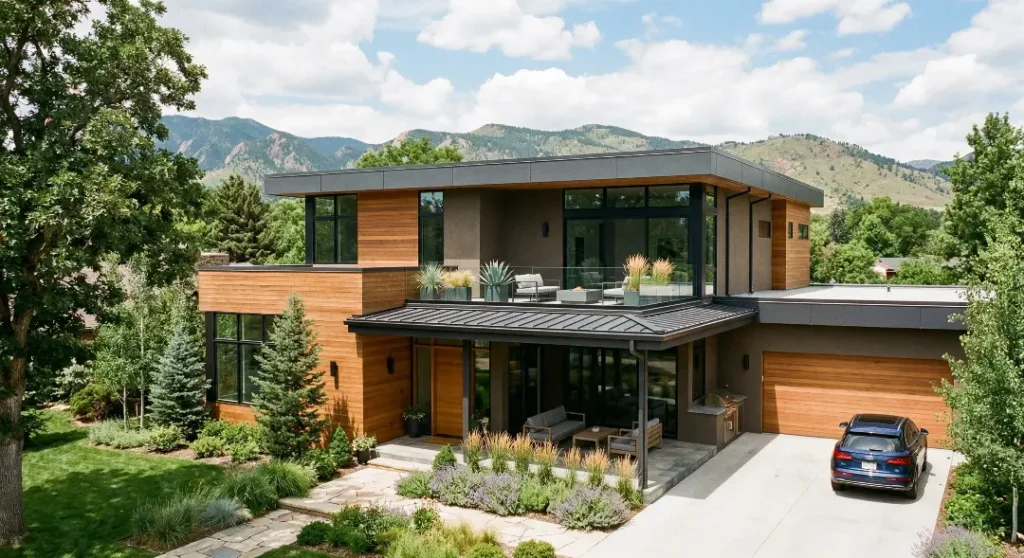
Flat roofs are no longer the default of commercial buildings. Single-ply membranes like TPO and PVC have reshaped residential flat roofing, offering homeowners durable, energy-efficient, and long-lasting alternatives to older built-up systems. This guide breaks down exactly how each material works, where each excels, and what to consider before making a decision.
How flat roof technology has evolved
Traditional flat roofs relied on built-up roofing (BUR), layers of tar and gravel stacked over felt paper. While BUR was reliable for decades, it came with significant weight load requirements, limited energy performance, and labor-intensive installation. Modified bitumen improved on BUR in the 1970s, but the real shift came with single-ply membranes in the late 20th century.
Today, TPO (thermoplastic polyolefin) and PVC (polyvinyl chloride) dominate the residential flat roofing market as the two leading single-ply options. Both are factory-manufactured in large rolls, installed as a continuous membrane, and heat-welded at the seams for a watertight bond. Their lightweight profiles, reflective surfaces, and chemical resistance represent a genuine generational leap in flat roofing materials.
If you are exploring your flat roofing system options, understanding the chemistry and performance characteristics behind each material is the most useful starting point.
What is TPO roofing?
TPO stands for thermoplastic polyolefin. It is a single-ply roofing membrane made from a blend of polypropylene and ethylene-propylene-diene monomer (EPDM), reinforced with a polyester scrim. The result is a flexible, highly reflective white or light-colored sheet that resists UV radiation, ozone, and chemical exposure.
TPO composition and how it is made
TPO membranes are typically manufactured in 10-, 12-, and 20-foot wide rolls. The scrim layer in the middle provides dimensional stability and tear resistance, while the top ply is compounded with UV stabilizers and flame retardants. The underside can be smooth (for mechanically attached systems) or fleece-backed (for adhered systems).
Because TPO is a thermoplastic, its seams are heat-welded with hot-air guns at approximately 1,000 degrees Fahrenheit. This creates a bond stronger than the membrane itself when done correctly, which is a key advantage over older systems that relied on adhesives or lap cement.
TPO reflectivity and energy performance
Standard white TPO membranes meet the Energy Star roofing product criteria, which requires an initial solar reflectance of at least 0.65 and a thermal emittance of 0.90. In warm climates this reduces cooling loads measurably. In the Pacific Northwest, the effect is more modest, but improved insulation compatibility (TPO bonds well with polyisocyanurate boards) still contributes to year-round thermal efficiency.
Note on membrane thickness: The industry often lists “nominal” thickness, which includes both the scrim and the top ply. A 60 mil nominal membrane may have only 20-25 mil of actual top-ply protection. When comparing products, ask for the reinforced membrane thickness specification, not just the nominal figure.
What is PVC roofing?
PVC roofing membranes are made from polyvinyl chloride plasticized with additives that make the rigid PVC polymer flexible enough for roofing applications. Like TPO, PVC is a single-ply thermoplastic membrane reinforced with a polyester or fiberglass scrim. PVC has been used in commercial and industrial roofing since the 1960s and has a considerably longer track record of performance than TPO.
What makes PVC different at the chemistry level
The critical difference between PVC and TPO is the plasticizer package. PVC requires plasticizers to achieve flexibility, and over time those plasticizers can migrate out of the membrane, causing it to become brittle. Modern formulations use higher-molecular-weight plasticizers that significantly reduce migration, but migration remains a long-term consideration in extreme-temperature environments.
On the other hand, PVC is inherently more resistant to oils, fats, and industrial chemicals than TPO. This is why PVC is the standard recommendation in environments with rooftop kitchen exhaust, grease exposure, or chemical discharge. For residential applications, this advantage is less pronounced but still relevant for homes with rooftop HVAC units that use refrigerant oils.
PVC fire resistance
PVC is self-extinguishing due to its chlorine content. When exposed to flame, it releases hydrogen chloride gas, which inhibits combustion. This gives PVC a Class A fire rating in many formulations without additional treatment. The National Fire Protection Association (NFPA) publishes standards covering membrane fire performance under standard 276, which governs flame propagation testing for roofing systems.
TPO vs PVC: side-by-side comparison
The table below compares both materials across the metrics that matter most for residential flat roofing decisions.
| Factor | TPO | PVC |
|---|---|---|
| Material composition | Polypropylene + ethylene-propylene rubber | Polyvinyl chloride + plasticizers |
| Standard thickness range | 45 mil, 60 mil, 80 mil | 45 mil, 50 mil, 60 mil, 80 mil |
| Seam welding method | Hot-air welding | Hot-air welding |
| Solar reflectance (white) | 0.72 – 0.80 | 0.70 – 0.78 |
| Thermal emittance | 0.90+ | 0.90+ |
| Chemical / grease resistance | Moderate | High (superior to TPO) |
| Fire rating (typical) | Class A (with appropriate assembly) | Class A (inherent chlorine resistance) |
| Cold-weather flexibility | Good (remains flexible in cold) | Good (modern formulations) |
| Plasticizer migration risk | None (no plasticizers) | Low to moderate (depends on formulation) |
| Track record in roofing | ~30 years | 60+ years |
| Recyclability | Recyclable (growing programs) | Recyclable (established programs) |
| Typical installed cost (residential) | $5 – $9 per sq ft | $6 – $12 per sq ft |
| Expected lifespan | 15 – 30 years | 20 – 30+ years |
| Manufacturer warranty (typical) | 10 – 20 years | 15 – 25 years |
Cost breakdown for residential projects
Flat roof pricing varies by roof area, slope, existing deck condition, insulation requirements, and local labor rates. The table below provides realistic ranges for a residential project in the Pacific Northwest.
| Cost component | TPO estimate | PVC estimate | Notes |
|---|---|---|---|
| Membrane material (per sq ft) | $1.50 – $2.50 | $2.00 – $4.00 | Varies by thickness and manufacturer |
| Polyiso insulation board (per sq ft) | $1.20 – $2.00 | $1.20 – $2.00 | Required for most flat roofs to meet code |
| Labor and installation (per sq ft) | $2.50 – $4.50 | $2.80 – $5.00 | PVC slightly higher due to membrane cost |
| Deck repair / preparation | $0 – $3.00+ | $0 – $3.00+ | Depends on existing deck condition |
| Flashings, drains, accessories | $300 – $800 | $350 – $900 | Flat fee range for most residential footprints |
| Total installed (1,000 sq ft roof) | $5,000 – $9,000 | $6,000 – $12,000 | Does not include structural repairs if needed |
Cost vs lifespan math: A TPO roof at $7,000 lasting 20 years costs approximately $350/year. A PVC roof at $10,000 lasting 28 years costs approximately $357/year. On a per-year basis the two materials are competitive once longevity is factored in. Material cost alone is not the deciding factor.
Understanding the full scope of a roof replacement also includes disposal of your existing system, permit fees (typically required in Washington state for full tear-offs), and any required upgrades to drainage or ventilation.
Installation methods and what they mean for you
Both TPO and PVC membranes can be installed using three primary methods. The choice of method affects labor cost, wind uplift resistance, and whether the roof can be re-covered in the future without a full tear-off.
| Installation method | How it works | Best for | Considerations |
|---|---|---|---|
| Mechanically attached | Membrane is fastened to the deck at seams using screws and plates, then seams are heat-welded | New construction, large roof decks, cost-sensitive projects | Allows thermal movement; can produce slight billowing in high-wind areas |
| Fully adhered | Membrane is bonded to insulation or deck using water-based or solvent-based adhesive across the entire surface | Residential applications, complex rooflines, high wind zones | Higher labor cost; superior uplift resistance; quieter in wind |
| Ballasted | Loose-laid membrane held in place by river rock or pavers | Commercial buildings with high structural load capacity | Rarely appropriate for residential; adds significant load to deck |
For most residential flat roofs, the fully adhered method is preferred. It distributes stress evenly across the deck, eliminates flutter noise, and delivers better uplift resistance in the wind-driven rain environments common across the Pacific Northwest. Proper roof installation technique including correct adhesive coverage and overlap dimensions is the single largest determinant of long-term performance.
The role of insulation
Flat roofs are almost universally installed with rigid insulation boards beneath the membrane. The Washington State Energy Code sets minimum R-value requirements for roofing assemblies, and polyisocyanurate (polyiso) is the most common choice due to its high R-value per inch (approximately R-6.5 per inch) and compatibility with both TPO and PVC.
Insulation details connect directly to roof ventilation and insulation strategy. A cold roof assembly (insulation above the deck) eliminates the risk of condensation forming within the assembly, which is particularly important in the humid PNW climate.
Climate considerations for the Pacific Northwest
Western Washington presents a specific set of performance demands for flat roofing membranes. The region receives 35 to 60+ inches of annual rainfall depending on location, with extended periods of overcast and mild temperatures rather than extreme heat or cold.
| Climate challenge | TPO performance | PVC performance |
|---|---|---|
| Sustained moisture exposure | Excellent – no moisture absorption | Excellent – no moisture absorption |
| Ponding water (poor drainage areas) | Good resistance | Good resistance |
| Freeze-thaw cycling at seams | Good – welds remain flexible | Very good – established long-term data |
| Moss and algae growth | Low susceptibility (smooth surface) | Low susceptibility (smooth surface) |
| UV exposure (less intense in PNW) | Excellent UV stabilizers | Excellent UV stabilizers |
| Wind-driven rain at seams | Excellent when heat-welded | Excellent when heat-welded |
| Foot traffic (maintenance access) | Moderate resistance – walk pads recommended | Good resistance – walk pads still recommended |
One often overlooked PNW consideration is drainage design. Both TPO and PVC membranes perform well only when the underlying deck has adequate slope to drain. Most flat roofs are not truly flat; they are designed with a minimum slope of 1/4 inch per foot. When drainage is inadequate and ponding water remains for more than 48 hours after a rain event, it accelerates membrane degradation over time regardless of material. A professional roof inspection and assessment will identify ponding areas before a new membrane installation begins.
Lifespan, warranties, and maintenance
Longevity data for TPO is somewhat limited compared to PVC because TPO was only widely commercialized in the early 1990s. PVC, by contrast, has roofing installations dating to the 1960s still performing in Europe, providing a much longer empirical track record.
| Warranty type | TPO typical range | PVC typical range |
|---|---|---|
| Manufacturer material warranty | 10 – 20 years | 15 – 25 years |
| Contractor workmanship warranty | 1 – 5 years (varies by contractor) | 1 – 5 years (varies by contractor) |
| No-dollar-limit (NDL) warranty | Available from major manufacturers | Available from major manufacturers |
| Condition for warranty validity | Licensed contractor installation required | Licensed contractor installation required |
Maintenance requirements for both membranes are relatively modest compared to traditional roofing systems. Annual maintenance tasks include clearing debris from drains and scuppers, inspecting flashings and penetrations for lifted edges, and checking seams visually for any separation. Regular roof repair and maintenance visits extend the service life of either membrane by catching minor issues before they become failures.
Environmental performance
Energy performance and environmental impact are increasingly important in residential roofing decisions. The U.S. Department of Energy’s Building Envelope research program has documented that cool roofs with high solar reflectance reduce peak cooling demand and contribute to urban heat island mitigation. The U.S. Environmental Protection Agency (EPA) Heat Island Effect program specifically lists white TPO and PVC membranes among recommended cool roof strategies.
Recyclability
Both TPO and PVC are thermoplastic materials, meaning they can in theory be remelted and reprocessed. Practical recycling infrastructure varies by region. The Vinyl Institute maintains a roofing membrane recovery program for post-installation PVC scrap. TPO recycling programs are expanding but less uniformly available. If end-of-life recyclability is a priority, ask your roofing contractor which programs they participate in before selecting a material.
TPO and PVC in green building certification
Both membranes can contribute to LEED (Leadership in Energy and Environmental Design) points through the Heat Island Effect category when reflectance and emittance values meet thresholds. The U.S. Green Building Council publishes the LEED rating system requirements for cool roofing credits, which white TPO and PVC can typically satisfy. Washington state has adopted progressive energy codes aligned with the 2021 International Energy Conservation Code (IECC), and flat roof insulation R-values have increased accordingly.
If your property has or is pursuing green building certification, roof coating and waterproofing upgrades can be combined with membrane replacement to optimize both energy performance and waterproofing continuity.
Which material is right for your home?
There is no universal answer. The right choice depends on your specific roof geometry, budget, exposure conditions, and how long you plan to stay in the home. The summary below captures the typical decision points:
TPO tends to be the better fit when:
- Budget is the primary constraint
- Roof has straightforward geometry
- No grease or chemical exposure is expected
- Energy Star reflectance is a priority
- Project is a new installation (less track record risk)
PVC tends to be the better fit when:
- Longer warranty coverage is preferred
- Rooftop HVAC or kitchen exhaust is present
- Decades-long performance data matters
- Plasticizer-free chemistry is not a concern
- Complex detailing around penetrations is involved
For homeowners managing ongoing storm damage restoration, a single-ply flat roof replacement is frequently paired with drainage and deck repair work. In those cases the material selection decision is best made after a full scope assessment, not before.
It is also worth noting that TPO and PVC represent only two of the available flat roof options for residential homes. EPDM (ethylene-propylene-diene monomer) is a rubber-based alternative with its own performance profile and cost range. A complete overview of available flat roofing systems including EPDM and modified bitumen can help frame the full decision landscape before committing to any single material.
A note on DIY installation: Neither TPO nor PVC should be considered a DIY roofing project. Hot-air welding equipment requires operator training and calibration for each membrane type and ambient temperature. Improperly welded seams are the leading cause of single-ply roof failures. Manufacturer warranties are also void without documentation of licensed contractor installation.
Upgrade to the Future of Flat Roofs: TPO vs. PVC
Don’t settle for outdated materials. Discover how to enhance your home’s efficiency and durability with the advanced flat roofing solutions offered by Fast Roofing NW. Your long-term protection starts with the right material choice.
Get a Free Estimate